Use Case 2: Variable-Rate Liming to Optimize Crop Yields and Improve Resource Efficiency in Germany
Overview:
Soil acidity is a critical factor affecting soil fertility and crop yield. In Germany, soil pH levels in agricultural fields often fall outside the optimal range, with 42% of arable soils and 57% of grassland soils showing low pH levels. Current liming practices, based on outdated guidelines, fail to account for soil variability, leading to inefficient resource use, blanket liming treatments that are tailored to no specific field area, and thus suboptimal crop growth.
Challenges:
- Traditional liming practices do not address field-scale soil heterogeneity.
- Existing liming guidelines are insufficient for current precision farming needs.
- Soil data for precision farming is limited to coarse classifications, causing inaccurate lime applications.
Smart Farming Applications Involved:
- Variable-rate liming
Expected Outcomes:
- Development of high-resolution lime requirement maps using autonomous sensor-based mapping, with reduced costs compared to current alternatives.
- More efficient liming strategies, improving soil acidity management, and improved farmer crop yields.
Updates
In Germany, SQAT partners ATB and EV ILVO are developing and testing approaches for variable-rate liming to improve soil fertility, optimize resource use, and support sustainable crop production.
Mapping soil variability at field scale
Since 2021, ATB has been developing the Leibniz Innovation Farm for Sustainable Bioeconomy – a large-scale research and testing environment covering 940 hectares of agricultural land.
As part of the SQAT activities, the farm was mapped using two mobile multi-sensor platforms equipped with four sensing technologies:
- Apparent electrical conductivity (ECa) sensors
- Optical red and near-infrared sensors
- Ion-selective pH electrodes
- Gamma-ray sensors
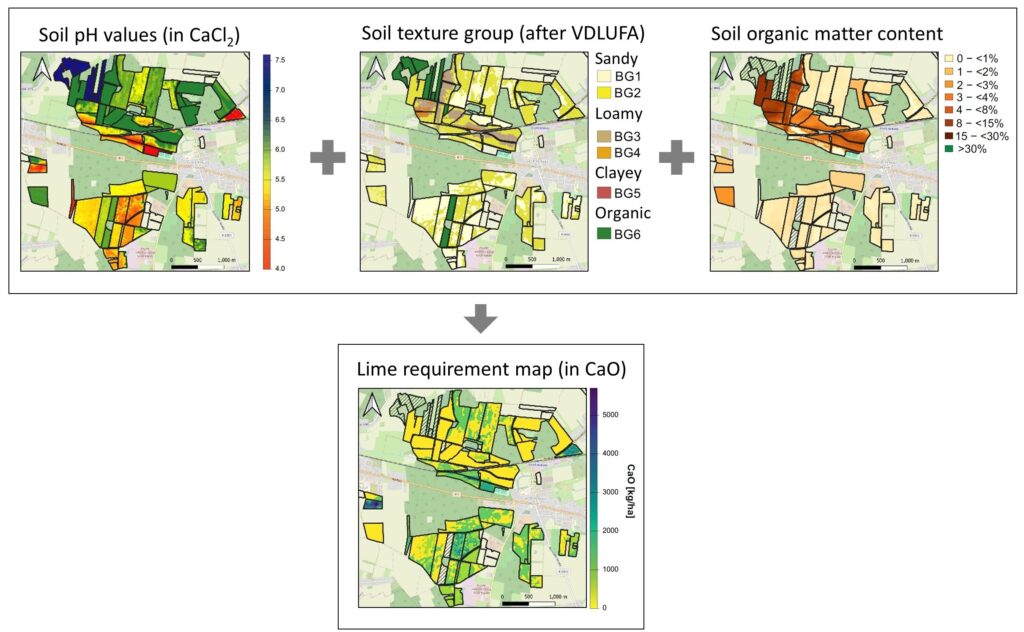
The sensor data were combined with laboratory analyses from reference soil samples to generate high-resolution maps of:
- soil pH
- soil texture
- soil organic matter
These soil property maps were then used to calculate lime requirement maps for site-specific variable-rate liming.
Why is variable-rate liming important?
Agricultural fields often contain significant soil variability. Applying the same lime rate across an entire field can lead to:
- oversupply in some areas
- undersupply in others
- inefficient resource use
- reduced crop performance
Variable-rate liming helps address this challenge by adjusting lime application according to local soil conditions. The aim is to bring the whole field closer to optimal pH levels, improving soil fertility while using resources more efficiently.
Supporting smarter farming decisions
This work contributes to SQAT’s broader objective of combining soil sensing, Earth Observation, and smart farming technologies to support more precise and sustainable agricultural management.
The results from this use case will also support future testing and validation of autonomous soil mapping solutions developed within the project.